

Authentic Brand Storytelling How Real Brands Build Trust
Authentic brand storytelling is the difference between content that looks good and content that actually works. You can spend serious money on visuals, campaigns and platforms, but if the story underneath is weak, people feel it instantly. They might like it. They might scroll past it. But they will not remember it.
Story is what makes people care. It is what makes brands feel human, believable and worth trusting.
My work does best when the story is as strong as the way it looks. I have seen marketing budgets disappear into content that is beautiful but empty. Pretty without purpose does not move people. Story does.
This article looks at authentic brand storytelling through psychology, filmmaking and real world brand work. Not hype. Not trends. Just what actually makes people connect.
Why authentic brand storytelling matters
People do not connect with logos. They connect with meaning. They connect with struggle, progress, personality and intention.
A strong story does three things.
It gives context.
It creates emotion.
It makes the brand feel real.
When brands skip story and jump straight to visuals, they often end up with content that looks polished but feels empty. It might be sharp. It might be expensive. But it does not land.
Authentic brand storytelling is not about pretending to be something. It is about showing what already exists, clearly and honestly, in a way people can feel.
What makes a story feel authentic
Authenticity does not mean messy. It means honest.
An authentic story usually has:
A real starting point
A real problem or tension
A real change
A real outcome
If there is no tension, there is no story. If nothing changes, there is no journey.
From a filmmaking point of view, this is basic structure. Every strong story has a beginning, middle and end. Even short brand films follow this, whether they realise it or not.
Beginning
Who is this for. Where are they now. What is missing.
Middle
What gets in the way. What is tried. What goes wrong or right.
End
What changed. What is different now.
That full circle is what makes a story satisfying. Without it, content feels unfinished.
Brand storytelling examples
Brand storytelling examples show how structure, emotion and intention work together when a story is designed, not decorated.
Some of the strongest modern brand stories follow very simple narrative logic:
A problem the audience recognises
A tension they feel personally
A journey they can see themselves in
A resolution that feels earned, not forced
For example:
Apple does not sell devices. It tells stories about creativity, rebellion and making things differently. Every product launch is framed as a moment of change, not a spec sheet.
Patagonia does not sell jackets. It tells stories about responsibility, endurance and respect for the world. Their products become symbols of values, not just items.
Nike does not sell trainers. It tells stories about struggle, belief and becoming more than you were yesterday.
These are not marketing tricks. They are story systems.
Each brand:
Knows its central belief
Knows its audience’s inner conflict
Builds every campaign around that tension
The reason these stories work is not because they look good. It is because they complete a full narrative loop:
Who am I?
What do I struggle with?
What could I become?
When your brand story answers those questions clearly, people do not just buy. They align.
And alignment lasts longer than attention.
The science behind why stories work

Stories work because the brain processes them differently than facts.
When people hear a story, multiple areas of the brain activate. Not just language, but emotion, memory and even movement. This is why people remember stories long after they forget data.
Researchers call this neural coupling. It means the listener’s brain begins to mirror the storyteller’s brain. That shared experience is what creates trust.
This is why brands that tell clear stories feel more believable. People are not just hearing them. They are experiencing them.
That is also why badly told stories feel fake. The brain knows when something does not flow.
If you want to go deeper into this, look into the science of storytelling and neural coupling and how it shapes memory and trust.
The filmmaker’s view of brand storytelling
From a filmmaking perspective, story is not something you add at the end. It is something you build everything around.
Before a single frame is shot, a strong brand story should answer:
Who is the hero?
What do they want?
What stands in the way?
What changes by the end?
The hero is rarely the brand. The hero is the customer, the user, the community or the team.
The brand is usually the guide. The mentor. The thing that helps change happen.
When brands make themselves the hero, stories feel forced. When the audience becomes the hero, stories feel personal.
When content looks good but fails
One of the biggest mistakes brands make is confusing beauty with meaning.
You can have:
Great lighting
Strong colour
Smooth motion
Clean design
And still have a weak story.
When that happens, people say things like:
“It looks nice but I do not get it.”
“It is cool but I forgot it.”
“It feels like an ad.”
That usually means the story was never built properly.
This is where money gets wasted. Not on quality, but on direction. You can pour budget into production, but if the story is unclear, it will not land.
This is why I always start with story first. If the story is right, the visuals know what to do.
The full circle of authentic brand storytelling
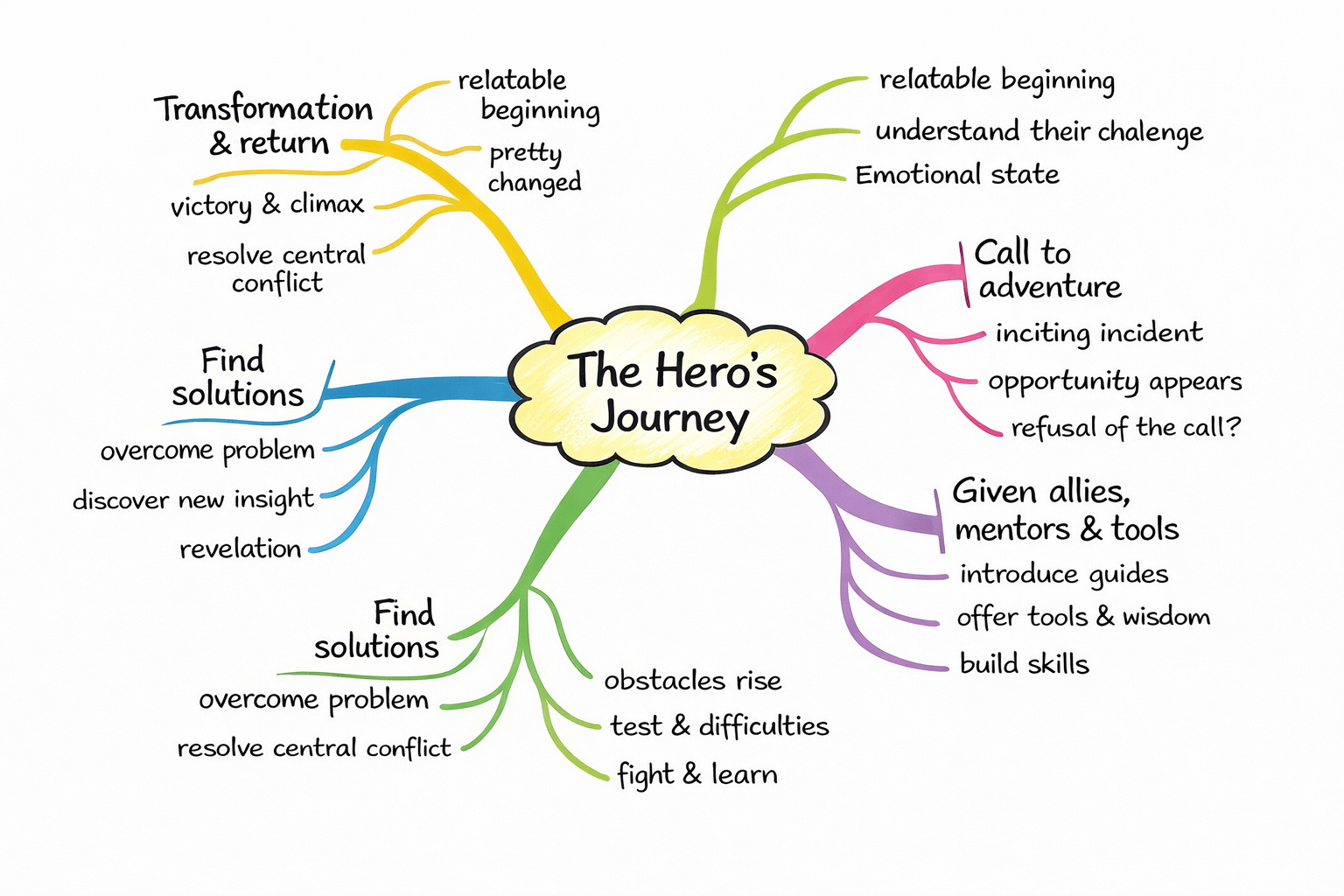
Ordinary world
Every story starts with normal life.
Your audience already has habits, frustrations and routines. They may not even know something is missing yet.
If you skip this stage, your story feels disconnected.
Call to change
Something makes them uncomfortable.
They think:
“This could be better.”
“I am tired of this problem.”
Great stories reflect the tension people already feel.
Struggle
Real change is not easy.
Fear appears.
Doubt shows up.
Risk feels real.
Stories without struggle feel fake.
The guide appears
You are not the hero.
Your audience is.
Your role is to guide, not dominate.
A good guide understands, supports and removes fear.
Action
Stories move when someone acts.
They try something new.
They trust.
They commit.
Result
Something changes.
They feel relief, clarity or confidence.
Emotion matters more than data here.
Return
They go back into their world changed.
They now carry the story with them.
They tell it to others.
That is how brands grow quietly.
Turning story into visual content
Once the story is clear, visuals become much easier.
Instead of asking “What should this look like?”
You ask “What should this feel like?”
Cameras, lighting, sound and movement should support the story, not distract from it.
This is the thinking behind my approach to Social media video production that actually tells a story, not just fills a feed.
Authentic brand storytelling in Glasgow
Storytelling is universal, but place still matters.
In Glasgow especially, people respond to honesty. They can sense marketing quickly. They respect real effort and real voices.
That is why authentic brand storytelling works well here. When brands show people, process and purpose clearly, trust builds faster.
This is the same approach I use across projects through creative storytelling through my Glasgow videography services, whether for brands, individuals or communities.
Why Great Stories Take Time (and Why That’s a Good Thing)
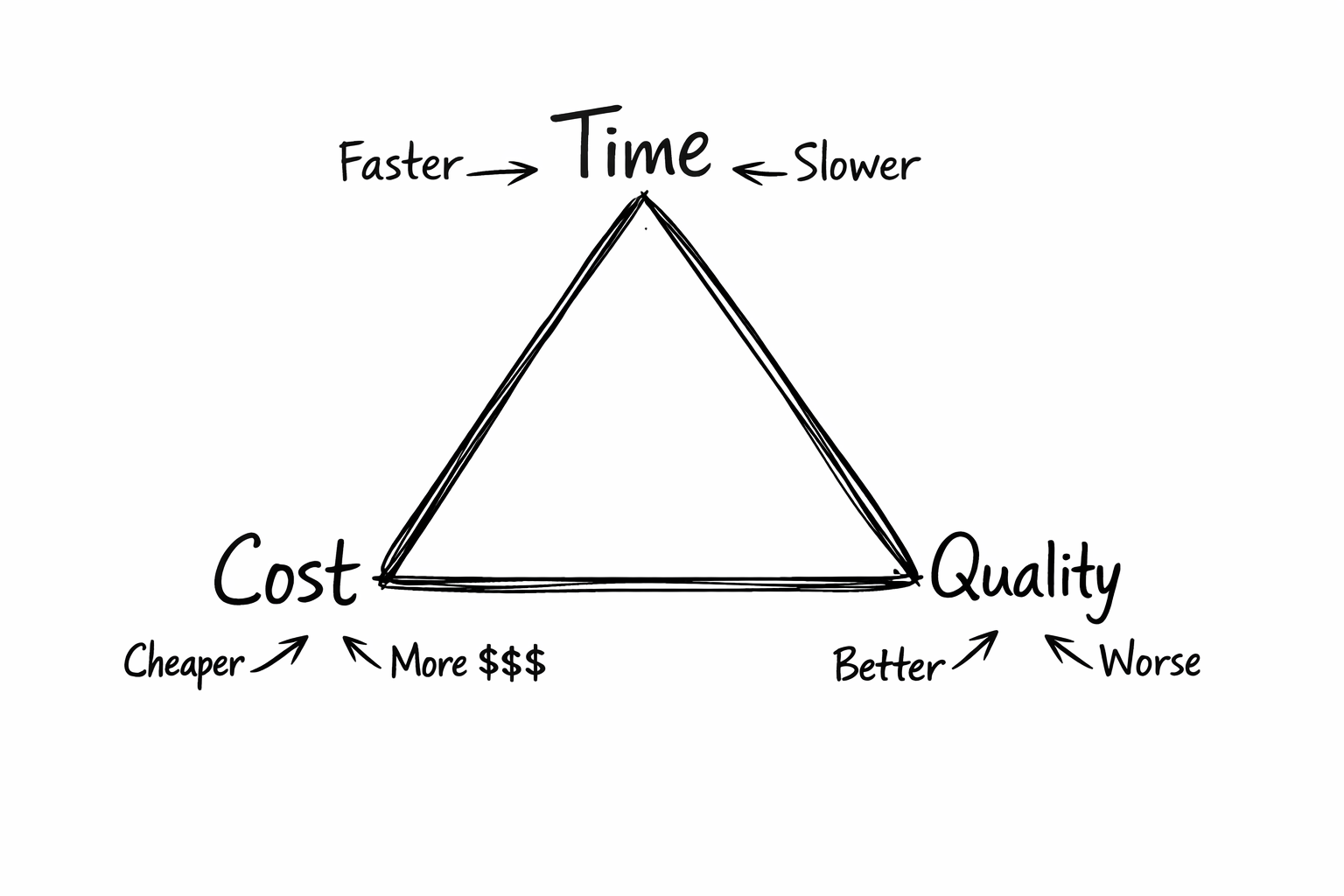
There is a simple truth in creative work: you cannot have everything at once. If you want something fast, cheap, and high-quality, you can only ever truly pick two.
That is what the triangle above shows. Time, money, and quality are linked. Pull one corner, and the others move.
When brands rush content to meet a deadline with no real planning, what usually comes out is what I call visual noise. It might look “cool” for a second. It might follow trends. But it rarely lands. It does not build trust, memory, or loyalty. It is just another piece of content in an already crowded feed.
Strong stories work differently.
A good story takes time because it needs thought. It needs research. It needs understanding of the people involved, the audience, and the reason the story even exists. It also often takes a bit more budget because collaboration costs. Time on location costs. Planning costs. Testing ideas costs.
But what you get back is not just content. You get something that connects.
Stories that land are rarely made in a rush. They are built through conversations, not just briefs. They come from asking why, not just what. They are shaped by both sides working together, not one person firing instructions at another.
This is where the real value is.
Generic content is easy to make. You can churn it out quickly. But it does not grow a following. It does not build belief. It does not make people care. It just fills space.
Stories do the opposite. They give people something to recognise themselves in. They make brands feel human. They create memory, not just impressions.
That is why storytelling is a collaborative effort. It is not a client handing over a list and walking away. It is a shared process of shaping meaning. The brand brings the truth. The creator brings structure. Together, you build something that lasts longer than a post, a reel, or a campaign.
If you want work that actually lands, that people remember, and that builds real connection, it usually costs a little more time and a little more effort. But what it saves you from is wasting budget on content that looks fine and means nothing.
Why story and visuals must work together
Story without visuals feels distant.
Visuals without story feel empty.
When they work together, they create memory.
My background has always been driven by story. Long before business, it was film, music and observation. Watching how people move, work and change.
That is why I care as much about story as I do about look. You can fake polish. You cannot fake meaning.
You can explore more of that thinking through my wider work at Alexander Thomas, where story always sits at the centre.
Learning from marketers too
Storytelling is not just creative. It is strategic.
From a marketing point of view, trust is built through clarity, consistency and relevance. One of the best breakdowns of this is in Neil Patel’s Blog, which looks at storytelling from an SEO and marketing psychology angle.
When creative and marketing thinking meet, stories travel further.
Bringing it full circle
Authentic brand storytelling is not a trend. It is how humans have always understood the world.
Brands that understand this stop shouting.
They start speaking.
They start listening.
They start connecting.
If your content looks good but does not move anyone, it is not a production problem. It is a story problem.
Fix the story, and everything else gets easier.
That is where real brand work begins.
